Platform Comparison
Why leading brands are replacing
Shopify, Oracle, Cegid, Manhattan, and Aptos
500+ stores
Giorgio Armani — live globally
140 stores · 60 days
Boggi Milano — 8 countries
1,500+ stores
55 countries
Founded 2020
Built post-pandemic, no legacy debt
If you’re evaluating your next retail platform, here’s how the options actually compare — and where each one breaks down under real enterprise pressure.
Not all retail platforms are built for the same problem
- •Digital-first eCommerce
- •Fast DTC scaling
- •SMB to mid-market
- ✕Store operations become complex
- ✕Omnichannel unification is required
- ✕Enterprise compliance matters
- •Large enterprise control
- •Deep system customisation
- •Established IT departments
- ✕Speed and agility matter
- ✕Deployment timelines are critical
- ✕Modern mobile-first UX is needed
- •European luxury and fashion
- •Multi-country retail operations
- •Compliance-heavy markets
- ✕Store operations become complex
- ✕Omnichannel unification is required
- ✕Enterprise compliance matters
- •Enterprise OMS and POS
- •Complex inventory management
- •Large store networks
- ✕Unified commerce is needed
- ✕Deployments must be fast
- ✕Store + digital must converge
- •Fashion and lifestyle brands
- •Modern composable OMS
- •API-first retail stacks
- ✕Real-time execution across all systems is needed
- ✕Store, fulfillment, and customer data must act as one
- ✕Integration complexity replaces — rather than eliminates — fragmentation
- ✓Unified real-time retail execution
- ✓Luxury and premium brands
- ✓Global multi-store operations
- ✓Weeks to deployment
- ✓Digital-only brands
- ✓Sub-10 store operations
The difference isn't features — it's architecture
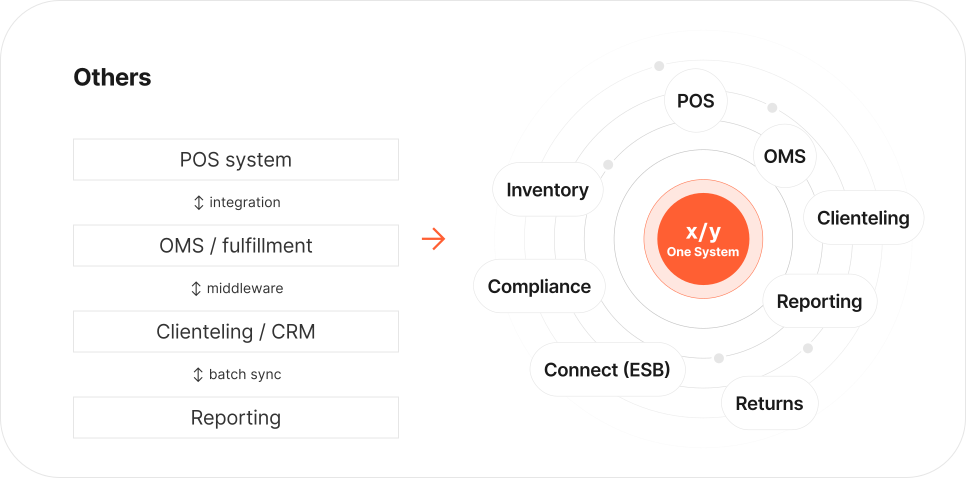
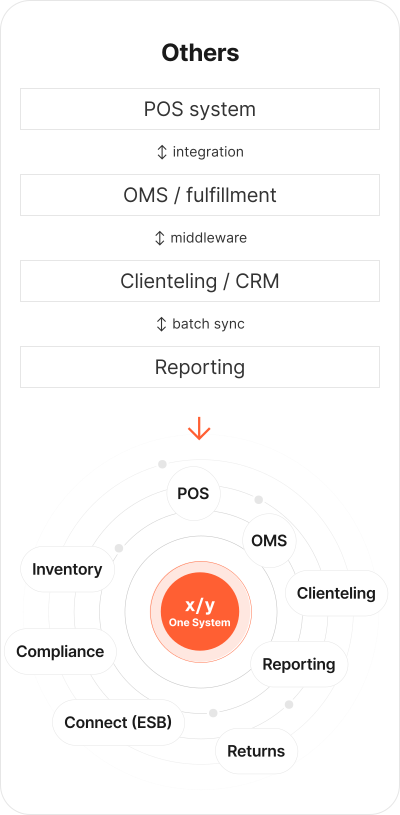
Every other platform on this page is built as a workflow system. Rules, queues, batch processing. XY is built as a real-time execution layer — every action happens live across the entire business, with no middleware in between.
This is why Boggi went from zero to 140 stores in 60 days.
Workflows don't move that fast. Execution does.
How the platforms actually compare
See this in practice
How Giorgio Armani replaced their retail stack across 500+ stores
Where XY is
fundamentally different
01
One system, not a stack
POS, OMS, clienteling — all separate, all out of sync. Every integration is a risk. Every change is a project.
02
Real-time execution
Inventory, pricing, fulfillment — updated live across the network. Every action happens now, not in the next overnight sync.
03
Deployment in weeks, not years
Boggi Milano: 140 stores, 8 countries, live in 60 days. XY's phased rollout model is built to move fast without breaking the brand experience.
140 stores · 8 countries · 60 days — Boggi Milano
04
Proven at luxury scale
Giorgio Armani runs 500+ stores globally on XY. Damiani, Isaia, Fender, Boggi. These are not pilots — they are live production operations.
500+ stores live — Giorgio Armani Group
05
Designed for luxury retail
Not adapted from a generic commerce platform. XY was built from the ground up for the operational reality of luxury and premium retail — clienteling, global compliance, multi-currency, brand experience.
06
Eliminates integration complexity — not just modernises it
Composable architectures replace legacy fragmentation with API fragmentation. XY removes the integration layer entirely — one system, no connectors to maintain, no sync failures between components.
When XY may not
be the right choice
We'd rather tell you this upfront than waste your time — or ours.

Small or digital-only brands
Shopify-first, single-channel businesses
Sub-10 store operations without omnichannel complexity
Looking for a standalone POS with no OMS requirements
Businesses not ready to move away from their existing ERP integration model
If you're in one
of these situations
We're outgrowing Shopify
→ XY replaces the fragmentation
Store operations, OMS, and clienteling unified in one system — without rebuilding your digital commerce layer from scratch.
Our POS and OMS are completely disconnected
→ XY eliminates the middleware
One system handles both in real time. No batch syncs, no overnight reconciliation, no inventory discrepancies between channels.
We're on Cegid but need to move faster
→ XY is the modern alternative
Store operations, OMS, and clienteling unified in one system — without rebuilding your digital commerce layer from scratch.
Deployments are taking 12–18 months
→ XY reduces rollout cycles dramatically
One system handles both in real time. No batch syncs, no overnight reconciliation, no inventory discrepancies between channels.
We're expanding globally and compliance is blocking us
→ XY has compliance built in
NF525 (France), ZATCA (Saudi Arabia), GDPR — certified and always current. No custom builds per market. No waiting on third-party compliance layers.
We've gone composable — but it's still fragmented
→ XY replaces integration complexity, not just legacy
Composable stacks move the problem — from monolithic systems to API dependencies. XY eliminates the integration layer entirely: one execution system where POS, OMS, and clienteling operate as one, not as connected components.
We need to replace Manhattan Associates or Aptos
→ XY is the unified replacement
Replace your OMS and POS simultaneously with one system that handles both in real time. Multiple brands have made this transition — ask us about the migration path.
Not a promise —
a production reality
Giorgio Armani
Replaced legacy infrastructure with XY across global operations
500+
stores live globally
50%
faster deployment cycles
60%
less operational complexity
Boggi Milano
Global rollout from zero to production in 60 days
140
stores across 8 countries
60
days to full production
240+
stores live today
See how this applies to your business
A 30-minute working session — not a generic demo
- Map your current systems
- Identify gaps and inefficiencies
- Show exactly how XY would run your business
This isn't a product demo. It's a working session on your business.
No generic pitch. No commitment. Just clarity.
Enterprise retail platform — answered directly
Is New Black a unified retail platform?
New Black is a composable OMS platform designed for modern fashion and retail architectures. It is strong for order management and API-first stacks, but typically requires integration with separate POS, clienteling, and inventory systems. XY Retail differs by providing a single platform where these functions are unified and operate in real time — eliminating integration complexity rather than modernising it.
What is the best enterprise retail platform for luxury brands?
The best platform depends on your requirements. Shopify Plus is strong for digital-first brands but lacks enterprise store operations depth. Oracle suits large legacy environments but deployment timelines are typically 12–24 months. Cegid is a strong European option for compliance-heavy markets. XY Retail is purpose-built for luxury and premium brands needing unified POS, OMS, and clienteling with real-time execution and fast global deployment.
What replaces Manhattan Associates OMS or Aptos POS?
XY Retail replaces both Manhattan Associates and Aptos by providing a unified system that handles OMS and POS in real time — without middleware. Brands that have replaced legacy OMS and POS stacks with XY include Giorgio Armani (500+ stores) and Boggi Milano (140 stores across 8 countries, live in 60 days).
What is an alternative to Cegid for luxury retail?
XY Retail is a modern alternative to Cegid for luxury and premium brands, particularly where real-time execution, mobile-first iOS operations, and fast multi-country deployment are priorities. XY includes NF525, ZATCA, and GDPR compliance built in — covering the same European compliance requirements as Cegid.
What is an alternative to Retail Pro for multi-country operations?
XY Retail replaces Retail Pro with a unified platform covering POS, OMS, and clienteling across multiple countries and currencies. Unlike Retail Pro, XY is built as a real-time execution system — not a workflow engine — enabling faster deployments and omnichannel operations without additional integration layers.
How long does an enterprise retail platform deployment take?
Legacy platforms like Oracle, Manhattan Associates, and Aptos typically require 12–24 months for enterprise deployments. XY Retail uses a phased rollout model that reduces this dramatically — Boggi Milano deployed 140 stores across 8 countries in 60 days. Actual timelines vary by store count and complexity.
What unified commerce platform works for luxury retail?
A unified commerce platform for luxury retail needs to handle in-store clienteling, real-time inventory across channels, global compliance, and premium associate experiences. XY Retail is purpose-built for this — currently powering Giorgio Armani, Boggi Milano, Damiani, Isaia, and Fender across 1,500+ stores in 55 countries.

One system.
Every retail action
Follow us on: