Blogs
Engineering XY to Be ABSTRACT - Compliant

Puneet Arora
Co-founder & CTO, XY Retail


Building a platform like XY is not about having the most features. It’s about having the right foundational principles so that features, integrations, and innovations can emerge organically, without breaking the system.
Puneet Arora
Co-founder & CTO, XY Retail
Engineering a Platform, Not a Product
When we began architecting XY, we didn’t start with features. We started with first principles.
Drawing on years of experience building and scaling complex enterprise systems across industries, we at XY decided to take a fundamentally different approach. Retail doesn’t suffer from a lack of software. It suffers from a lack of adaptable, extensible infrastructure. Most enterprise solutions are hardcoded, inflexible, and opinionated in ways that break the moment a brand needs to do something different.
That’s not a software problem. It’s a platform philosophy problem.
From “This Is Broken” to “What Actually Makes Sense?”
When we started building XY, we didn’t ask, “What do other retail systems do?” We asked, “What would we build if we were starting from scratch today?”
That meant throwing out a lot of sacred cows.
- Most retail systems hardcode object definitions. Products, stores, orders - all rigid, all predefined. We asked, Why? Why can’t a “Store” flex based on geography or compliance? So we built Entities that are graph-based and self-descriptive (as illustrated in the XY Graph below).
- Most systems treat integrations as a mess of scripts and patches. We asked, Why isn’t every part of the system API-native from the beginning? So we exposed everything - from pricing to fiscal endpoints - so external systems can talk to XY like it's a living organism.
- Most platforms slow down at scale or break under localization needs. We asked, Why should adding a new country mean duplicating environments or branching the product? So we built a configuration-first engine on top of our abstract data model that adapts without code rewrites.
“Best practices” are often just legacy decisions no one had time to rethink.
We didn't copy what others had done. We interrogated why those things existed in the first place. In XY, agility is an architectural consequence of how we store, model, and process data.
Everything is built to be configurable, extensible, and observable. Because modern retailers need to move faster than their tech stack typically allows.
The Principle of ABSTRACT
XY was designed to be ABSTRACT-compliant - not as a marketing label, but as a reflection of our foundational design principles:
- Agile
- Brand-first
- Scalable
- Real-time
- API-native
- Composable
- Trusted
Each principle maps directly to a system-level decision we made in the architecture. Together, they define how the platform evolves.
Agility Starts With the Data Model
One of the most powerful expressions of agility is in our Abstract Data Model. It’s how we solve for scale across sub-verticals, geographies, and even individual brands, without rewriting the core system.
In XY, every object - Product, Store, Customer, Order - is an Entity. And Entities can be extended with additional Entities. A “Store” isn’t a flat record with fixed fields, it can have a “Store Profile,” “Fiscal Config,” “Visual Identity,” and more, each of which are extensible, linkable entities themselves. This builds a graph of relationships, not a rigid table.
You don’t need to fork the product to support a new country or a new compliance requirement. You define it. Link it. Extend it. And you’re done.
That’s agility. That’s abstraction.
Composable, Not Chaotic
Another early decision: build the platform as a structured composition of services, not a tangle of microservices for the sake of it. Composability in XY means you can adopt OMS without POS, or POS without clienteling. But it also means each module works together natively if you choose to go all-in.
This approach supports:
- Regional rollouts
- Gradual migrations
- Partner-led customizations
- And experimentation without risk
Compliance Built In, Not Bolted On
With clients operating across dozens of fiscal jurisdictions, trust and compliance had to be built into the platform. Not patched in.
Whether it’s NF525 in France, ZATCA in Saudi Arabia, or evolving global privacy laws, our platform adapts through configuration - not core changes. That’s the power of our abstract model in practice: no matter how specific the need, the platform responds without breaking.
Real-Time, Everywhere
From day one, XY was built to be real-time and event-driven. We stream, we don’t poll. Every interaction - inventory update, order status, customer activity - is captured and pushed through the platform instantly. That’s why we can support rich omnichannel workflows, accurate store visibility, and real-time recommendations - globally, across brands and geographies.
Principles Over Patches
Building a platform like XY is not about having the most features. It’s about having the right foundational principles so that features, integrations, and innovations can emerge organically, without breaking the system.
This is what ABSTRACT-compliance means to us. It’s not a checklist. It’s a blueprint.
And if you’re a developer, partner, architect, or retail brand ready to build on a future-ready foundation - we built this for you.
A Closer Look at the XY Graph
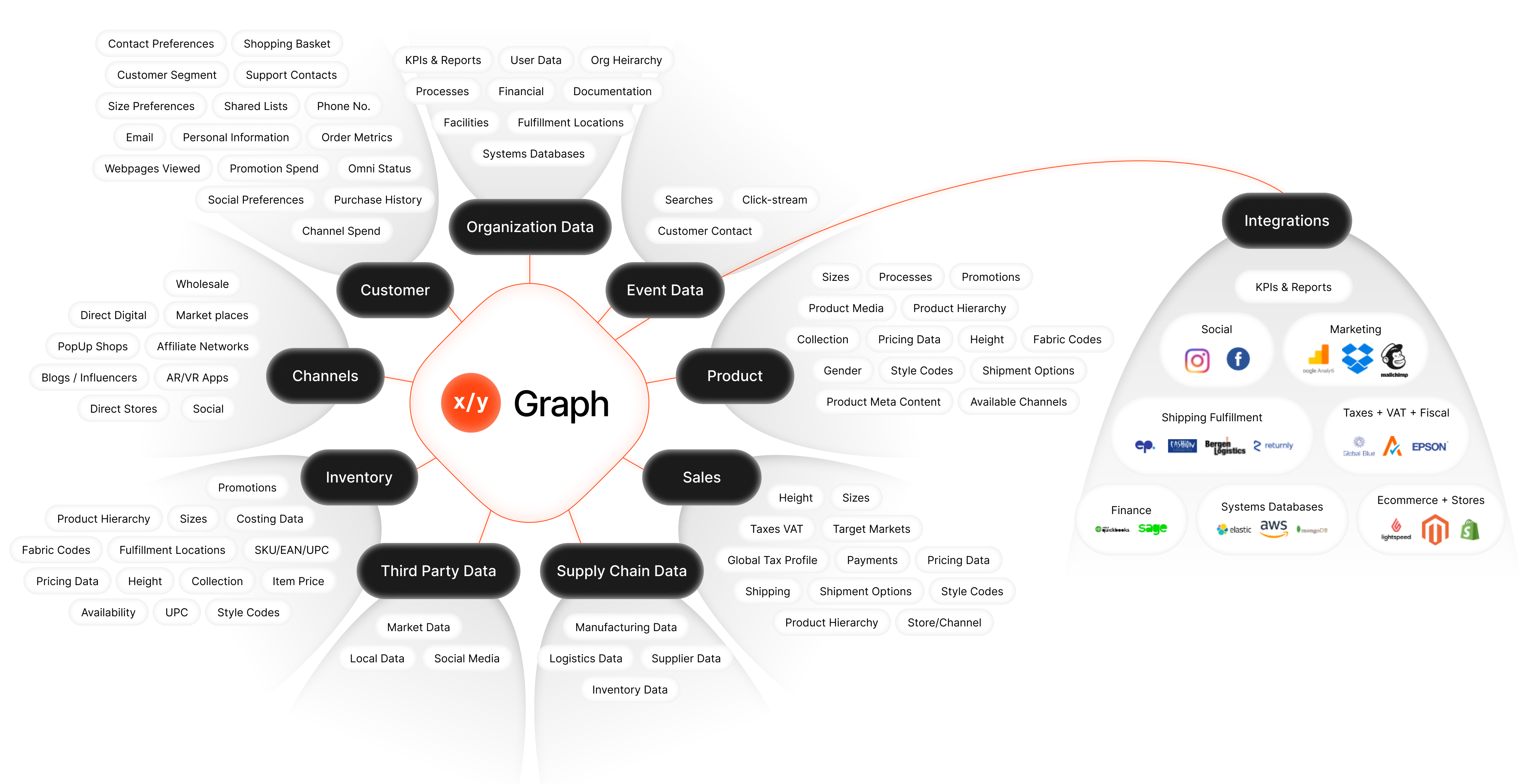
One of the earliest architectural decisions we made at XY was to treat every core concept - Customer, Product, Inventory, Store, etc. - as an extensible, modular Entity. That’s where our abstract data model begins.
What you see above isn’t a traditional master data schema. It’s a graph of relationships, designed to grow as your business evolves: Each black node represents a foundational entity. Each white node is a directly linked attribute or sub-entity. Want to extend “Customer” with loyalty behaviors? Or “Product” with fiscal pricing rules for France? Or “Store” with fiscal printer configs in Italy? You simply link a new entity. No rewrites. No redeployments.
This model allows us to:
- Handle regional complexity without branching code
- Configure deep logic through relationships, not hardcoding
- Enable partners to build custom entities around our model
This is abstraction in action. It’s how we support precision without rigidity, and scale without chaos.
TL;DR
We didn’t build XY to compete with other retail systems.
We built it because none of them made sense anymore.
Do you wanna know more?
Blogs
Strategic advice, retail news, and POVs from the team




One system.
Every retail action
Follow us on: